Blog
Blog

 About us
 Instagram QB Tools
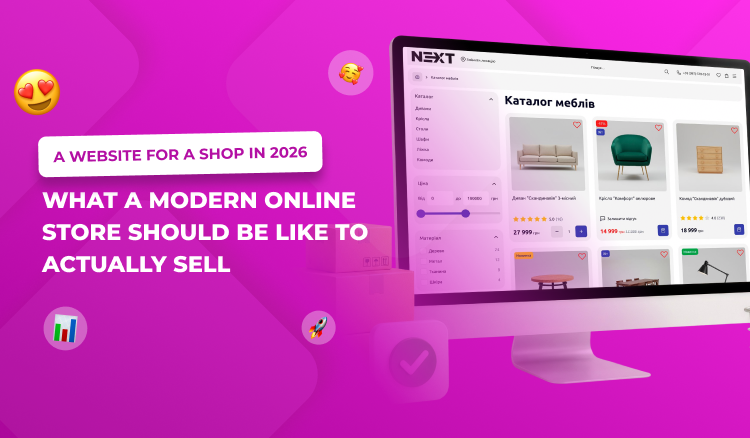
A store website can no longer be considered only as an online catalog.
A buyer comes to a website not just to look at the assortment.
They want to find a product, understand its characteristics, see the price, place an order and receive the purchase in a convenient way.
Therefore a modern store website should be built around one main task:
make the purchase as simple as possible.
A website is your own store on the internet
Social networks and marketplaces can bring sales.
But they should not be the only digital channel of the company.
Your own website allows the business to control:
- catalog;
- prices;
- promotions;
- client base;
- loyalty program;
- order placement;
- communication;
- brand;
- analytics.
QB Tools positions the website for a store as a solution for accepting delivery and takeaway orders with support for a loyalty system and the possibility of integration with CRM.
Why a client leaves a website without buying
Sometimes the problem of a store is not at all in the assortment.
The problem is in excessive complexity.
For example, a client:
- found a product;
- opened the card;
- did not understand the delivery conditions;
- started looking for information;
- went to another page;
- closed the website.
The sale is lost.
Therefore a modern website should answer key questions right during the purchase:
What is this?
How much does it cost?
When will I receive it?
How to pay?
Can I pick it up myself?
Are there bonuses or a discount?
A catalog should help choose
For a large assortment a simple product grid is not enough.
You need:
- categories;
- filters;
- search;
- sorting;
- characteristics;
- product variants;
- recommendations.
This shortens the path from search to purchase.
And recommendations can increase the average check.
For example:
A client buys shampoo.
The system recommends a mask and conditioner.
A client buys dog food.
The website shows treats or accessories.
This is a simple mechanic, but it directly affects the commercial result.
A website should support online and offline
If a company has physical stores, the website should not exist separately from them.
A buyer can:
- order a product online;
- pick it up in a store;
- pay online;
- use bonuses;
- get a consultation;
- return for the next purchase.
This is how an omnichannel model is formed.
The client does not care where “online” ends and “offline” begins.
For them it is one brand.
Delivery as a competitive advantage
Speed and clarity of delivery directly affect the purchase decision.
Therefore a website should show the client a clear scenario of receiving the order.
QB Tools allows automating delivery, takeaway, calculation of delivery cost and online payment.
This is important not only for the client.
Automation reduces the number of manual operations of a manager.
Loyalty should work for a repeat purchase
One of the main problems of online stores is that a client can buy once and never return.
A loyalty program changes this model.
A client accumulates bonuses.
Sees their balance.
Receives discounts.
Uses bonuses during the next purchase.
Thus the store creates a reason to return.
Personalization is one of the key e-commerce trends
A universal offer for everyone is gradually losing effectiveness.
If a store knows a client’s purchase history, it can show more relevant products.
To a person who regularly buys a certain category, new items in exactly this category can be offered.
To regular buyers special conditions can be shown.
This turns a website from a catalog into a personalized sales channel.
Mobile version is no longer an option
A significant part of users go to stores from smartphones.
Therefore a website must be convenient for a small screen.
Buttons must be of sufficient size.
The order form — short.
The cart — clear.
Payment — simple.
A client should not enlarge the page with their fingers to find the “Buy” button.
A ready-made website instead of long development
Your own individual online store can be created for months.
But a business often needs to sell right now.
That is why ready-made solutions become a practical alternative.
The website for your store by QB Tools is already oriented toward accepting orders, delivery, takeaway, loyalty and integration with CRM.
This allows the business to focus on assortment, marketing and sales, and not spend resources on creating basic technological infrastructure.
A website as the center of a digital ecosystem
The most interesting begins when a website works together with other tools.
For example:
website → mobile application → CRM → warehouse → delivery → loyalty → analytics.
The client sees a simple store.
And inside an automated system works.
This is how digitalization starts to affect not only marketing, but also operational efficiency.
What website a store needs today
A modern website is not just design.
It is:
catalog + order + payment + delivery + takeaway + loyalty + CRM + analytics.
If a website does not help a client buy quickly, it remains only an expensive business card.
If it automates sales, communication and repeat purchases — it becomes a full-fledged business tool.
Check out the ready-made website for your store from QB Tools and learn how to launch your own online sales channel without developing a complex system from scratch.

 Support chat